
 Buy Online


Ingredients in sunscreen products – which ones are harmful, what are the EU regulations, and how do ingredient-checking apps work?
Choose a sunscreen with SPF 30–50 and broad-spectrum UVA and UVB protection, and evaluate the INCI list according to concentration, method of use, and the overall formula. A long chemical name does not prove that a sunscreen is dangerous.
How do different types of sun protection work?
Mineral, organic, and combined filters reduce the UV radiation from sunlight reaching the skin and provide broad-spectrum protection.
What is the difference between UVA and UVB rays?
UVB rays cause sunburn. UVA rays penetrate deeper and contribute to photoaging and pigmentation.
What does SPF indicate?
SPF measures protection against UVB, not the amount of time it is safe to stay in the sun. According to the European Commission guidelines for sunscreen products, the UVA symbol in a circle indicates that UVA protection reaches at least one third of the stated SPF.
What are the active ingredients in sunscreen products?
The active ingredients are UV filters that limit the effect of sunlight on the skin and provide protection against UVA and UVB rays. The remaining components provide stability, texture, hydration, and easy application of the sunscreen.
Key active ingredients and UV filters
Different filters provide protection against certain parts of the UVA and UVB spectrum. Therefore, sunscreen products often combine several active ingredients.
INCI ingredient | Type | Main function |
|---|---|---|
Zinc Oxide | mineral filter | UVA and UVB protection |
Titanium Dioxide | mineral filter | UVB and part of the UVA spectrum |
Diethylamino Hydroxybenzoyl Hexyl Benzoate | organic filter | UVA protection |
Ethylhexyl Methoxycinnamate | organic filter | UVB protection |
Bis-Ethylhexyloxyphenol Methoxyphenyl Triazine | organic filter | broad-spectrum UVA/UVB protection |
Ethylhexyl Triazone | organic filter | UVB protection |
Butyl Methoxydibenzoylmethane | organic filter | UVA protection |
Ethylhexyl Salicylate | organic filter | UVB protection |
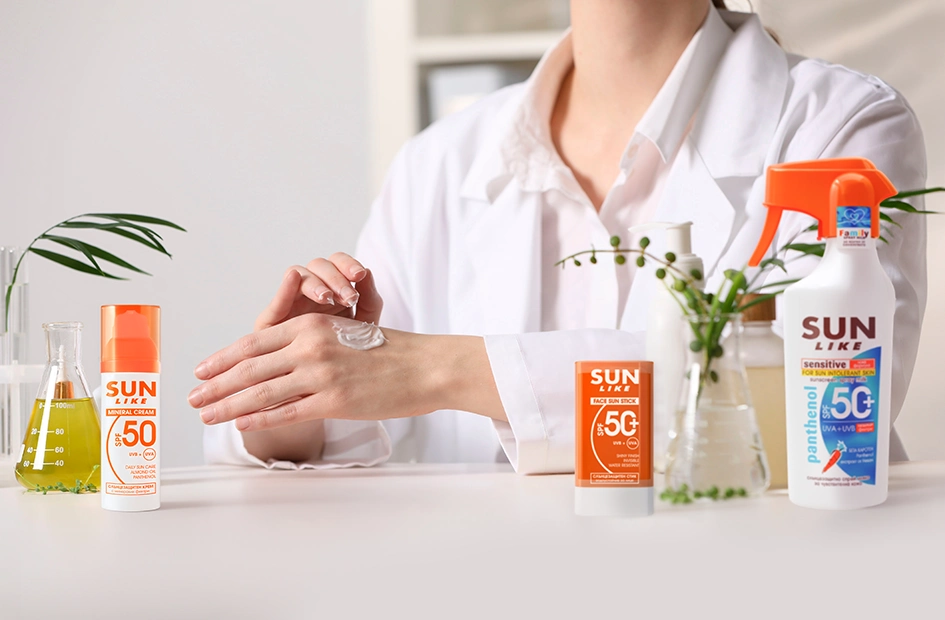
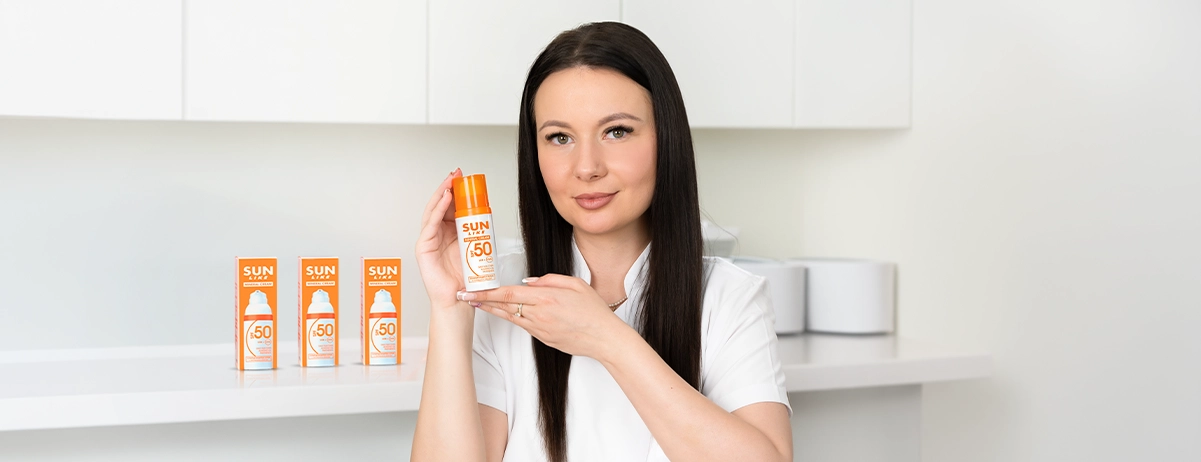
Zinc oxide and titanium dioxide are active ingredients of mineral origin. The SUN LIKE SPF 50 facial sunscreen with mineral filters uses Zinc Oxide, while organic formulas combine UVA and UVB filters. Titanium Dioxide is another example of a mineral filter. Broad-spectrum UV protection is determined by the composition and testing of the final product.
What is the difference between mineral and chemical sunscreens?
The main difference is in the type of UV filters and the feel on the skin. The words “chemicals” and “chemical ingredients” do not automatically mean danger.
Criterion | Mineral sunscreens | Chemical sunscreens |
|---|---|---|
Type of UV filters | Zinc Oxide, Titanium Dioxide, or a combination of both | Organic filters such as Ethylhexyl Methoxycinnamate, Ethylhexyl Triazone, and others |
UVA and UVB protection | Depends on the filter used and the overall formula | Several filters are usually combined for broad-spectrum protection |
Texture | Often leaves a visible trace, except in nano-particle formulations. | Allows the creation of lightweight and transparent textures |
Sensitive skin | Often preferred by people with sensitive skin, but tolerance is individual | May also be suitable for sensitive skin if the overall formula is developed for this skin type and is well tolerated |
Safety | Assessed according to concentration and the final product | Assessed according to the same regulatory criteria |
Mineral filters are often preferred for sensitive skin, but this does not mean that organic filters contain harmful ingredients. Tolerance depends on the entire formula, not only on the type of filter.
Which are the harmful ingredients in sunscreens?
There is no universal list of harmful ingredients in sunscreens that is valid at every concentration and for every use. It is more accurate to talk about frequently discussed UV filters rather than automatically dangerous ingredients. The assessment takes into account dose, absorption, and exposure conditions. Concerns about the endocrine system or estrogen should be considered in relation to actual exposure.
Oxybenzone
Oxybenzone is permitted in the EU at specific concentrations and under specific conditions of use. Its presence in the INCI does not automatically prove that a sunscreen product is dangerous.
Octocrylene
According to the SCCS assessment of octocrylene, this UV filter is safe up to 10% in most cosmetic products and up to 9% in aerosol products.
Homosalate
In the SCCS scientific opinion on homosalate, it is considered safe up to 7.34% in face creams and pump sprays. The same restriction was introduced through Regulation (EU) 2022/2195.
Octinoxate
Octinoxate, also known as Ethylhexyl Methoxycinnamate, is an organic filter. According to the current SCCS assessment of this UV filter, it is safe up to 10%, including in sunscreen products for children.
The reviewed Sun Like products do not use oxybenzone, octocrylene, or homosalate. However, this does not mean that these UV filters are automatically dangerous in every sunscreen product. Their safety depends on the concentration, method of use, and overall formula.
Which ingredients are safe for people and the environment?
Safety for people and environmental impact are assessed according to different criteria. For the skin, concentration, method of use, and overall formula are important, while environmental assessment considers how ingredients behave after entering water and nature.
Therefore, a sunscreen ingredient should not be defined as safe or harmful solely based on its name in the INCI. Data on actual exposure, permitted concentrations, and the intended use of the final product are necessary.
Safe ingredients for people
Safe sunscreen ingredients are permitted mineral and organic filters used at allowed concentrations and assessed as part of the final product.
Environmental impact
Environmental assessment is different from human health assessment. Data on how oxybenzone and octinoxate may affect coral reefs do not automatically demonstrate a risk to humans.
Are sunscreens dangerous as a whole?
Sunscreen products are not dangerous as a category when they meet the requirements and are used correctly. The use of sunscreen products reduces the proven risks associated with UV radiation.
How are sunscreens regulated in Europe?
According to European legislation on cosmetic products, sunscreens in Europe must undergo a safety assessment and notification in the CPNP. Permitted UV filters are listed in Annex VI to Regulation (EC) No 1223/2009.
What do comparative studies show?
In a randomized study of 1,621 adults, daily sunscreen use was compared with use at personal discretion. During follow-up, 11 primary melanomas were reported in the daily-use group versus 22 in the control group – HR 0.50; 95% CI 0.24–1.02.
Some filters can penetrate the bloodstream. The U.S. Food and Drug Administration states that the detected absorption requires further assessment, but by itself does not prove harm.
With sensitive skin, allergic reactions, skin irritation, or other irritation may occur. Test the product on a small area and discontinue use if a reaction occurs.

How do apps assess sunscreen ingredients?
Apps provide preliminary information about individual ingredients, but they cannot independently determine the safety of an entire sunscreen product. Their assessments usually do not take into account the exact concentration, method of use, SPF test results, and interactions between components.
Therefore, use apps as a helpful tool for reading the INCI, not as a final source for determining the presence of harmful ingredients. Compare the results with the label, manufacturer's instructions, and official European sources.
What do Yuka and INCI Beauty show?
The apps compare products on the market and provide information about mineral and chemical sunscreens. However, searching for sunscreen ingredients does not show the exact concentrations, SPF test results, or interactions within the formula.
INCI Beauty rates products on a scale from 0 to 20, while Yuka's rating is influenced by the ingredient with the highest assigned risk level.
What does CosIng show?
The European Commission's CosIng database provides information about the function and regulatory status of cosmetic ingredients. It is informative in nature and does not independently assess the safety of a specific formula.
How do we choose a safe sunscreen?
Sunscreen cosmetics are safe when they meet European requirements, are suitable for the specific skin type, and are used according to the instructions. When choosing a sunscreen, check the level of protection, the formula, and the method of application.
Check the protection
Choose a sunscreen with SPF 30–50 and broad-spectrum UVA and UVB protection.
Match the formula to your skin
Check which area the product is intended for – face or body – and whether the formula is adapted to specific needs, such as sensitive or children's skin. If you are prone to irritation, check for fragrance and known allergens, regardless of whether you are considering mineral or chemical sunscreens.
Follow the instructions
Recommendation 2006/647/EC on the efficacy of sunscreen products specifies a test dose of 2 mg/cm². This is equivalent to approximately 36 g, or six teaspoons, for the body of an average adult.
Check the water resistance, expiry date, and instructions for reapplying sunscreen products to ensure adequate protection from UV rays. Reapply protection after swimming, sweating, or wiping.
Which ingredients are a valuable addition to sun protection for babies?
Zinc oxide is a broad-spectrum mineral UV filter that provides protection against UVA and UVB rays. The specific level of protection depends on its concentration, distribution within the formula, and testing of the final sunscreen product.
Glycerin, panthenol, vitamin E, and aloe have a supporting role. They help with hydration, soothe the skin, and improve comfort, but they do not provide SPF protection on their own.
For babies under six months, the primary protection is shade, lightweight summer clothing with long sleeves and legs, and a hat. If the use of sunscreen cosmetics is necessary, seek advice from a pediatrician beforehand. Do not skip protection in order to obtain vitamin D.
Daily SPF protection is the most important choice
The most suitable sunscreen is one that provides reliable UVA and UVB protection, feels comfortable on the skin, and is used regularly. The Sun Like range offers formulas with mineral or organic UV filters. You can choose SPF 50 protection for the face and tattooed skin or a convenient SPF 50+ stick for easy application.
Regardless of the formula you choose, apply a sufficient amount and reapply protection after swimming, sweating, or wiping. Consistent SPF use is more important than concern caused solely by the long and unfamiliar name of an ingredient.
Author: Desislava Frangova


